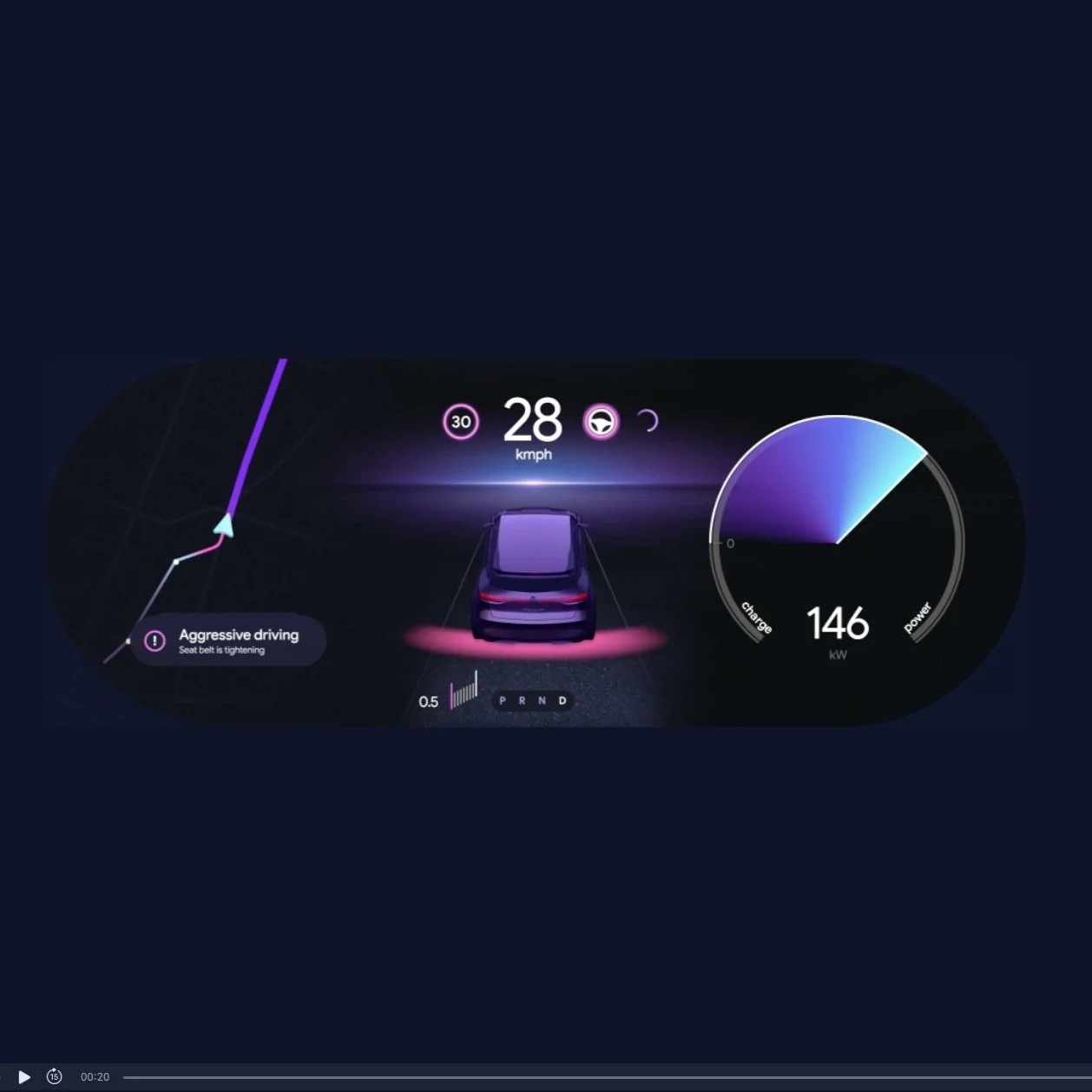
Making driving safer
Autoliv had already built a standalone app that tracked real-time driving behaviour and translated it into a personalised Safety Score. It worked. Drivers could review their habits, understand risk, and improve over time. But the bigger ambition was clear.
What if safety feedback didn’t live on a phone at all? What if it lived inside the car’s native experience — embedded directly into the HMI, where decisions actually happen? We partnered to make that shift real.
Designing for native integration
This wasn’t about porting an app onto a larger screen. It was about rethinking the experience entirely.
We set out to integrate Safety Score directly into the OEM interface using Android Automotive. The goal was seamlessness. No clunky transitions. No feature compromises. No sense that this was an external add-on. The feedback needed to feel like it was designed with the vehicle, not bolted on after.
The first step was immersion. We embedded with the OEM’s technical and design teams to understand the architecture, design system, and data protocols that governed the platform. Every interaction had to respect the language of the car — visually, technically, and behaviourally. Then we built in tight cycles. Prototype. Test. Refine. Repeat.
Alpha testing took place in controlled environments with scenario-based trials and rapid feedback loops. Early insights pushed us to simplify visual feedback, refine how alerts surfaced alongside core vehicle notifications, and reduce cognitive load at speed.
Beta testing moved into real-world driving with OEM testers. That’s where nuance emerged. Drivers needed customisation based on driving style. Feedback had to be actionable in the moment, not just reflective after the fact. Guidance needed to be clear without becoming distracting.
Each iteration brought the system closer to something that felt native, intuitive, and genuinely helpful.
The outcome
The result is a fully integrated, OEM-grade version of Safety Score — responsive, real-time, and context-aware. It operates within the vehicle’s interface as if it were there from day one. Safety feedback is no longer a retrospective report on a smartphone. It’s a proactive layer woven into the driving experience itself.
The product is currently under OEM review, with strong traction and potential for full rollout. For Autoliv, it represents a meaningful step forward — shifting safety from reactive protection to continuous behavioural improvement.
Why it matters
Modern vehicles are becoming software-defined platforms. In that world, safety can’t be limited to airbags and impact mitigation. It must extend into behaviour, awareness, and prevention.
By integrating Safety Score directly into the HMI, we helped redefine safety as something dynamic and adaptive — not just something that activates in a crash, but something that helps prevent one.
Behind the scenes
This was a true cross-functional lift — spanning hardware, embedded systems, UX, behavioural science, and OEM governance. Our role was strategic partner and integration lead, ensuring user needs, technical constraints, and road safety priorities stayed aligned.
Because in automotive, trust is earned not through features, but through feeling. And safety, when done right, feels invisible — until it matters most.