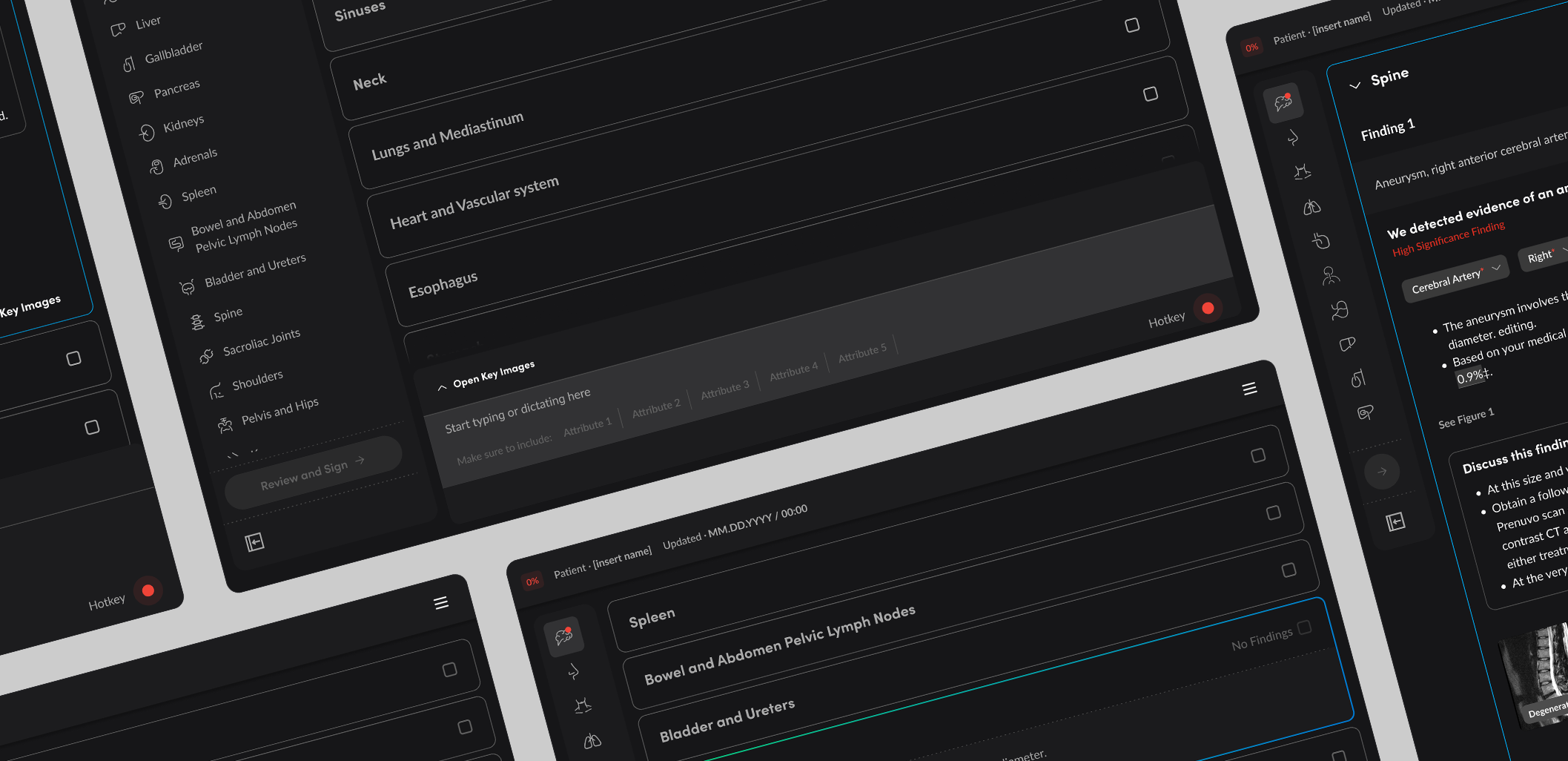
Designing the diagnosis
Radiologists work in a world measured in seconds.They interpret complex imaging under constant pressure, knowing that clarity and speed directly affect patient outcomes. Yet much of their time is consumed not by diagnosis, but by documentation — typing reports or dictating into systems that introduce delay and error.The friction wasn’t clinical. It was operational.
We saw an opportunity to remove that burden. Not by replacing expertise, but by amplifying it.
From administration to intelligence
The ambition was clear: design a voice-enabled AI tool that simplified documentation, reduced error, and allowed radiologists to focus on what matters most — making the right call.
But this wasn’t simply a speech-to-text problem. The system needed to understand complex medical language with near-human accuracy. It needed to fit seamlessly into existing workflows, particularly the hanging protocols radiologists rely on. And it needed to transform unstructured dictation into structured, usable data. We began where all meaningful design begins — with people.
Through interviews and workflow shadowing, we observed the full diagnostic rhythm. Where hesitation occurred. Where context switched. Where errors crept in. We built low-fidelity prototypes and placed them into real environments early, refining based on real usage rather than assumptions.
The key insight was simple: enhancement beats disruption. The product had to feel like an extension of the radiologist’s expertise, not another system to manage.
Engineering trust
Speech recognition and natural language processing were layered in deliberately. We started narrowly, training the AI on single-body-part workflows to reach human-level accuracy before expanding further. Contextual cues, intelligent prompts, and personalisation reduced cognitive load rather than adding to it.
Dictation was automatically structured into report-ready formats. The system understood radiology-specific terminology, capturing findings, associated imagery, and recommendations in real time. Documentation became dynamic rather than retrospective.
Crucially, privacy and compliance were built in from the start. In healthcare, trust is non-negotiable.
The outcome
The impact was tangible.Documentation time decreased by 40%, freeing radiologists to review more cases without increasing fatigue. User satisfaction increased by 30%, reflecting reduced friction and improved workflow integration. And the structured data generated through the platform unlocked real-time business insights — enabling operational optimisation and future automation opportunities.
What began as a documentation tool evolved into intelligent infrastructure for diagnostic practice. Radiologists weren’t just working faster. They were working better — with technology that amplified expertise instead of interrupting it.